Artelys Knitro - Nonlinear optimization solver

Nonlinear optimization problems arise in numerous business and industry applications: portfolio optimization, optimal power flow, nonlinear model predictive control, Nash equilibrium problems. To address these challenging problems, customers in hundreds of sites worldwide rely on Artelys Knitro for its efficiency and robustness.

Artelys Knitro has been developed by Ziena Optimization since 2001. Since the acquisition of Ziena and its development team in 2015, Artelys is in charge of the software development and distribution worldwide.
The most advanced solver for nonlinear optimization
Solve nonlinear optimization problems with millions of variables. Learn more.
Efficient & robust solution on large scale problems
Four interior-point/active-set algorithms for NLP
Three MINLP algorithms for discrete optimization
Complementarity constraints for equilibrium problems
Parallel multi-start method for global optimization
Many extra features based on customer feedbacks
Easy to use and well documented

Widely used in academia and industry
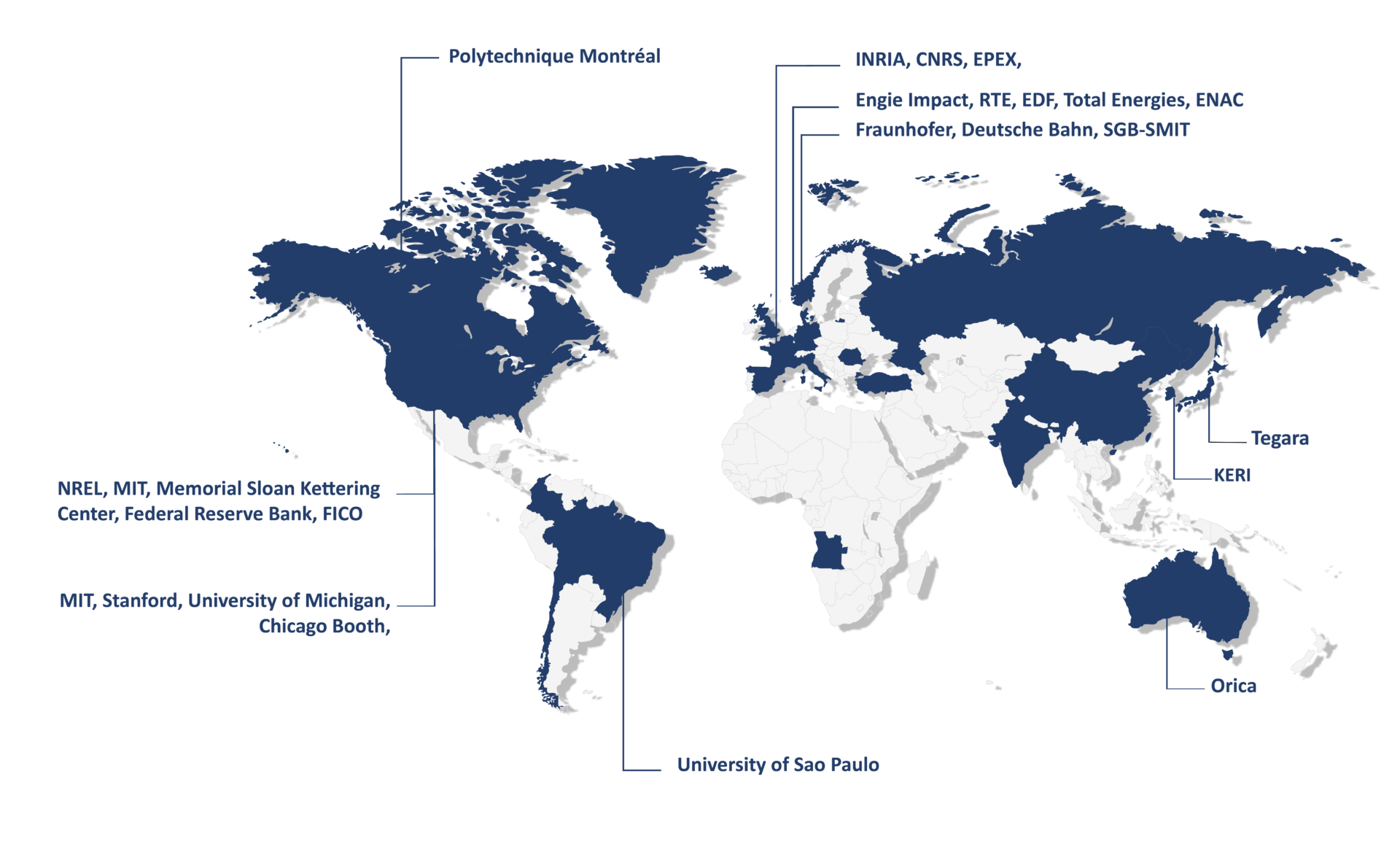
More than 300 institutions in over 40 countries rely on Artelys Knitro. Learn more.
Top universities:
Berkeley, Columbia, Harvard, MIT, Princeton, Stanford
Cath. Univ. of Chile, Univ. of São Paulo
ESSEC, ETH Zürich, LSE
Nat. Univ. of Singapore, Tsinghua Univ.
Univ. of Melbourne, Univ. of Queensland

Artelys Knitro users map
Industries:
Economic consulting firms
Financial institutions
Mechanical engineering companies
Oil & Gas companies
Regulatory & Policy makers
Software developers (as a third-party)
Get Artelys Knitro
Artelys Knitro is available for businesses, software vendors, academics and research institutes. Learn more.
Companies
Artelys Knitro is available as a stand-alone component or can be embedded into larger package (e.g., OEM software). Artelys’ consultants (PhD-level) are used to deploying enterprise-wide optimization solutions and will help you get the best performance out of Artelys Knitro. Contact us for further information.
Universities and Research Centers
Artelys offers partnership programs with universities, public training and research centers to promote teaching and research in optimization. Academic partners get Artelys Knitro at a discounted prices. Contact us for further information.
Try it for free!
If you wish to try our solver first, click here to download a trial license and start using it now.
Think one step ahead and let Artelys Knitro be your competitive advantage!
The optimization techniques used by Artelys Knitro offer the leading combination of computational efficiency and robustness. Artelys Knitro is the only nonlinear solver with four different algorithms, allowing it to solve a large range of complex nonlinear problems.
Key features
• Efficient and robust solution on large scale problems
• Two interior-point/barrier and two active-set/SQP algorithms
• Three algorithms for mixed-integer nonlinear optimization
• Heuristics, cutting planes, branching rules for MINLP
• Special routine to handle complementarity constraints
• Parallel multistart feature for global optimization
• Ability to run multiple algorithms concurrently
• Automatic and parallel tuning of option settings
• Automatic computation of approximate first-order and second-order derivatives
• Smart initialization strategies and fast infeasibility detection
New Artelys Knitro 10.3 features
• The Python API now supports Python 3
• New "cg_precond" option for the preconditioning of the conjugate gradient subproblems in the Knitro interior-point algorithms
• Several improvements to the internal linear algebra for better robustness and efficiency
• Significant improvements in large-scale least-squares models
• Improvements in the “feasibility restoration phase” leading to a faster detection of infeasible models
• Several enhancements of the R interface
• Overall efficiency and robustness improvements on general nonlinear models, including models with integer variables
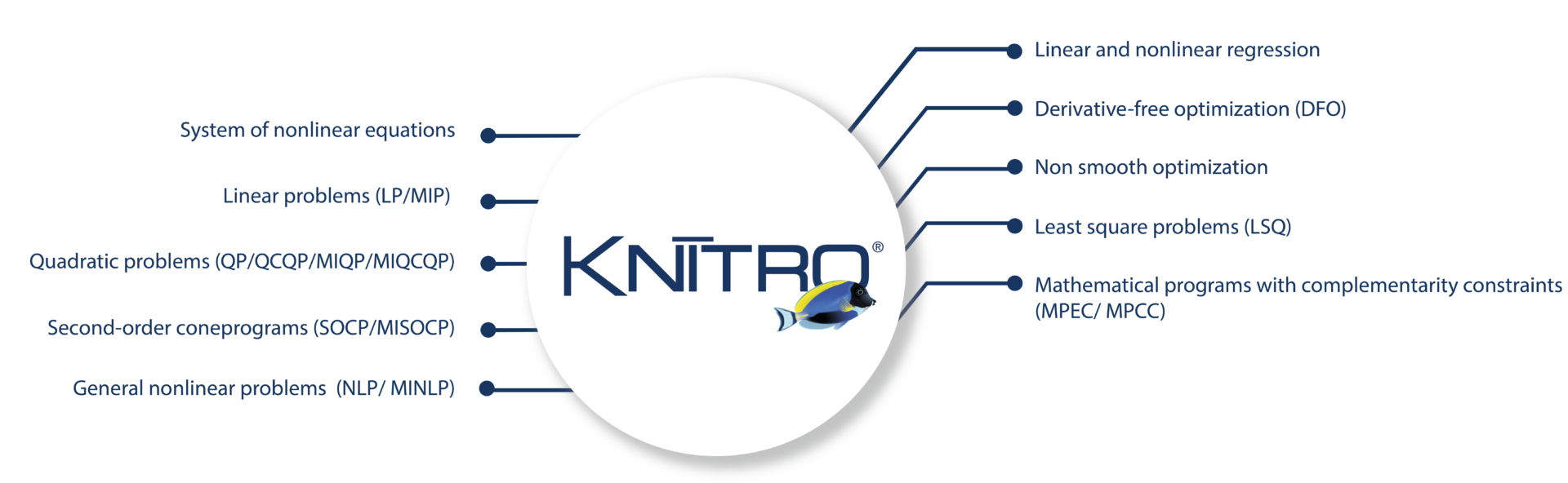
Problems classes solved by Artelys Knitro
• General nonlinear problems (NLP), including non-convex
• Systems of nonlinear equations
• Linear problems (LP)
• Quadratic problems (QP/QCQP), both convex and non-convex
• Least squares problems / regression, both linear and nonlinear
• Mathematical programs with complementarity constraints (MPCC/MPEC)
• Mixed-integer nonlinear problems (MIP/MINLP)
• Derivative-free optimization problems (DFO)
Programming interfaces

Modeling systems

Artelys Knitro and MATLAB
Artelys Knitro presents an interface to the MATLAB® computing environment that supports all major features in Knitro, including the ability to model and solve mixed-integer programming (MIP) models and mathematical programs with equilibrium constraints (MPEC). This interface, called “knitromatlab”, supersedes the previous ktrlink interface provided by the MATLAB Optimization Toolbox. Knitromatlab uses an API very similar to the MATLAB fmincon nonlinear optimization tool, providing an easy mechanism for porting code between the two, while also making available the enhanced features in Artelys Knitro. Extensive example and documentation on using knitromatlab are provided with the Knitro distribution and described in the Artelys Knitro User's Manual.
Artelys Knitro and AMPL
AMPL is a popular modeling language for optimization that allows users to represent their optimization problems in a user-friendly, readable, intuitive format. Artelys Knitro provides a dedicated driver “knitroampl” to use it from AMPL. Knitroampl gives access to all the solver features. Extensive example and documentation on using knitroampl are provided with the Knitro distribution and described in the Artelys Knitro User's Manual.
Artelys Knitro and R
R is an open-source software environment for statistical computing, available under GNU General Public License. It is developed and maintained by the R Foundation. Artelys Knitro provides a dedicated library to use it from R. The Artelys Knitro R library gives access to all the solver features and includes a dedicated function for solving nonlinear least-squares. Extensive example and documentation on using Knitro from R are provided with the Knitro distribution and described in the Artelys Knitro User's Manual.
Operating systems

Business & academic applications
Artelys Knitro is currently used in many application areas, thus demonstrating its versatility.
This section details some of the typical applications of Artelys Knitro with references to the academic literature. From fundamental mathematics to sustainable development, Artelys Knitro was found useful by a large range of Operations Research practitioners.
Feel free to contact us to receive more information regarding Artelys Knitro and its success stories.
Financial & banking
Optimization methods play a vital role in option pricing, portfolio selection and strategic bidding. Modeling and software solutions lend valuable assistance in decision making.
Typical uses of Artelys Knitro:
• Portfolio optimization with transactions costs
• Optimal pricing and risk management
• Volatility estimation
• Credit risk
• Strategic bidding and auctions (Nash equilibrium)
In the literature:
• Byrd, J. R., and Liu, Z. (2007): "Nonlinear Optimization Methods with Financial Applications". John Birge summarizes financial applications and the role that nonlinear optimization methods play in their solution.
• Nocedal, J. (2008): "The ZIENA Solver for American Options Pricing". Jorge Nocedal discusses the robustness, speed and ease of use of the software engine for real-time trading of options.
Computational economics & game theory
Typical uses of Artelys Knitro:
• Design of economic policies
• Yield management
• Demand modeling
• Maximum-likelihood estimation
• Nash equilibrium
In the literature:
• Conlon, C. T. (2009): "A Dynamic Model of Costs and Margins in the LCD TV Industry", Unpublished manuscript.
• Hanson, D. A., Kryukov, Y., Leyffer, S., and Munson, T. S. (2009): "Optimal Control Model of Technology Transition", No 2009-E24, GSIA Working Papers from Carnegie Mellon University, Tepper School of Business.
• Dubé, J.-P., Fox, J. T., and Su, C.-L. (2012): "Improving the numerical performance of static and dynamic aggregate discrete choice random coefficients demand estimation", in Econometrica, 80 (5), 2231-2267.
• Egesdal, M., Lai, Z., and Su, C.-L. (2012): "Estimating Dynamic Discrete-Choice Games of Incomplete Information", Working paper.
Statistics & data analysis
Typical uses of Artelys Knitro:
• Nonlinear least squares analysis (regression / data fitting)
• Support vector machines
• Data mining
• Data clustering
• Inference analysis
• Parameter estimation
• Inverse problems
In the literature:
• Wang, G., Zhu, Z., Du, W., and Teng, Z. (2008): "Inference Analysis in Privacy-Preserving Data Re-publishing", Data Mining, 2008, ICDM '08, Eight IEEE International, 1079-1084.
• Fuchs, M., and Neumaier, A. (2010): "Optimization in latent class analysis", Technical Report TR/PA/10/89, CERFACS.
• Rauchs, G., and Dumitriu, D. (2010): "Indentation testing parameter identification using an optimization procedure based on genetic algorithms", in Proc. of the Romanian Academy, Series A: Mathematics, 10 (2), 165-172.
Energy
Management of distribution networks, optimal plant operations, revenue and risk management, and strategic pricing play an increasingly important role in the energy sector.
Typical uses of Artelys Knitro:
• Nonlinear (AC) optimal power flow (OPF) problems
• Security-Constrained OPF (SCOPF) problems
• Optimization of generation costs and transmission losses
• Modeling of head effects in the optimal management of water reservoirs Nonlinear OPF (optimal power flow) problem
• Oil & gas production optimization
Business cases:
• Artelys: "Optimal power flow computations using Knitro". Business case: Tractebel Engineering – Optimizing electricity transmission system management.
In the literature:
• Plantenga, T. (2006): "KNITRO for Nonlinear Optimal Power Flow Applications". Artelys Knitro is used to solve OPF problems, including cost minimization, multi-objective optimization, and stochastic programming.
• Eka Suwartadi, Stein Krogstad, Bjarne Foss (2010): "Second-Order Adjoint-Based Control for Multiphase Flow in Subsurface Oil Reservoirs", 49th IEEE Conference on Decision and Control.
• Hu, B., Cañizares, C. A., and Liu, M.(2010): "Secondary and Tertiary Voltage Regulation Based on Optimal Power Flows", Bulk Power System Dynamics and Control (iREP) - VIII (iREP), 2010 iREP Symposium, 1-6.
• Gutierrez-Martinez, V. J., Cañizares, C. A., Fuerte-Esquivel, C. R., Pizano-Martinez, A., and Gu, X. (2011): "Neural-Network Security-Boundary Constrained Optimal Power Flow", IEEE Transactions on Power Systems, 26 (1), 63-72.
• Ferreira, E. C., Baptista, E. C., and Soler, E. M. (2012): "An investigation about barrier parameters update strategy and the Optimal Power Flow Solution", EngOpt 2012, 3rd International Conference on Engineering Optimization.)
• Barragan Hernandez, A., Vazquez-Roman, R., Rosales-Marines, L., Garcia-Sanchez, F. : "A strategy for simulation and optimization of gas and oil production", Computers and Chemical Engineering 30, 2005, 215–227
Sustainable development
Typical uses of Artelys Knitro:
• Virtual population analysis
• Population growth management
• Transition path control
Business cases:
• Artelys: "Optimizating harvesting of fish populations". Business case: Finnish Forest Research Insititute (Metla).
In the literature:
• Tahvonen, O. (2008): "Optimal harvesting of age-structured fish populations", CEMARE Research Paper, P165.
• Tahvonen, O., Pukkala, T., Laiho, O., Lähde, E., and Niinimäki, S. (2010): "Optimal management of uneven-aged Norway spruce stands", in Forest Ecology and Management, 260 (1), 106-115.
Optimal control & dynamic optimization
Typical uses of Artelys Knitro:
• Trajectory optimization
• Optimization with partial differential equations
• PDE-Constrained optimization with discrete decisions
• Variational Analysis
In the literature:
• Abdallah, L., Haddou, M., and Khardi, S. (2010): "Optimization of operational aircraft parameters reducing noise emission", in Applied Mathematical Sciences, 4 (11), 515-535.
• Nahayo, F., Khardi, S., Ndimubandi, J., Haddou, M., and Hamadiche, M. (2010): "Two-Aircraft Acoustic Optimal Control Problem: SQP algorithms", in ARIMA, 14, 101-123.
• You, F., and Leyffer, S. (2011): "Mixed-Integer Dynamic Optimization for Oil-Spill Response Planning with Integration of a Dynamic Oil Weathering Model", in AIChE Journal, 57 (12), 3555-3564.
Telecommunication
Typical uses of Artelys Knitro:
• Transmission network optimization
• Resource allocation
In the literature:
• Sosa-Paz, C., Ruckmann, J., and Sánchez-Meraz, M. (2010): "Joint Routing, Link Scheduling and Power Control for Wireless Multi-hop Networks for CDMA/TDMA Systems", in Científica, 14 (4), 165-172.
Optics & spectroscopy
Typical uses of Artelys Knitro:
• Light polarization control
• Isomer conformational analysis
In the literature:
• Lott, G. A., Perdomo-Ortiz, A., Utterback, J. K., Widom, J. R., Aspuru-Guzikb, A., and Marcus, A. H. (2011): "Conformation of self-assembled porphyrin dimers in liposome vesicles by phase-modulation 2D fluorescence spectroscopy", in Proceedings of the National Academy of Sciences, 108 (40), 16521-16526.
• Tripathi, S., Paxman, R., Bifano, T., and Toussaint, K. C. Jr. (2012): "Vector transmission matrix for the polarization behavior of light propagation in highly scattering media", in Optics Express, 20 (14), 16067-16076.
Mathematics & geometry
Typical uses of Artelys Knitro:
• Shape curvature minimization via contour regularization
• Independent proof check
• Counterexample detection
In the literature:
• Hales, T. C., and McLaughlin, S. (2010): "The dodecahedral conjecture", in Journal of the american mathematical society, 23 (2), 299-344.
• Bretin, E., Lachaud, J.-O., and Oudet, E. (2011): "Regularization of discrete contour by Willmore energy", in Journal of mathematical imaging and vision, 40 (2), 214-229.
Artelys Knitro documentation
User manual (PDF versions):
Artelys License Manager documentation
Artelys Knitro licensing
• Artelys Knitro Commercial Licensing
• Artelys Knitro Academic Licensing
• Artelys Knitro End-User License Agreement
Download a trial version
Frequently asked questions
This section has a selection of general issues encountered during the installation or the use of Artelys Knitro and our answers to help you. For specific help, please contact us.
Purchase and use ►
Q: What should I do to purchase Artelys Knitro?
A: Please contact Artelys Knitro sales team.
Q: Can I use all interfaces if I purchase the Artelys Knitro solver through a modeling language's website?
A: No. When Artelys Knitro is purchased through a modeling language vendor, Artelys Knitro can only be used through that particular modeling language or interface. To embed Artelys Knitro in a C/C++ or FORTRAN program, you must purchase the full Artelys Knitro libraries through Artelys.
Installation ►
Q: Why does get_machine_ID.exe say the machine ID could not be determined?
A: On Windows this may happen if your machine is not connected to a network. The machine ID includes an Ethernet address, but Windows does not make the address available unless the network connection is enabled. See the Ziena License Manager User's Manual for details.
Q: What should I do when I have difficulties installing Artelys Knitro?
A: Read sections Installation and Troubleshooting of the user manual. If you cannot resolve your problem, please contact Artelys Knitro support team (for users under maintenance only).
Tips & tricks ►
Q: What should I do to make Artelys Knitro solve my problem faster?
A: Read section Tips and Tricks of the user manual. If you cannot resolve your problem, please contact Artelys Knitro support team (for users under maintenance only).
Q: Where can I discuss with the Artelys Knitro community?
A: The Artelys Knitro forum is hosted by a Google group. You can refer to the Artelys Knitro community to discuss about Artelys Knitro, provide feedbacks, ask technical questions, etc. Anyone can view the discussions. To post a message you need to sign into Google, but Google accounts are free.
Technical references ►
Q: Which article should I mention if I want to add a reference to Artelys Knitro in my paper?
A: If you need to mention Artelys Knitro in a publication, please insert the following reference:
R. H. Byrd, J. Nocedal, and R. A. Waltz, "KNITRO: An Integrated Package for Nonlinear Optimization" in Large-Scale Nonlinear Optimization, G. di Pillo and M. Roma, eds, pp. 35-59 (2006), Springer-Verlag.
Q: Where can I read more information about the algorithms implemented inside Artelys Knitro?
A: Read section Bibliography of the user manual.
Discussion groups ►
• Artelys Knitro Forum: Help group for Artelys Knitro; ask technical questions, report experiences, suggest tips.
• Artelys Knitro Linkedin Group: Business group for Artelys Knitro; share your experience with other Artelys Knitro users and be kept informed of all the new developments.
Artelys Knitro support
Artelys provides worldwide technical support and assistance for Artelys Knitro.
More informationArtelys Knitro support
Artelys provides worldwide technical support and assistance for Artelys Knitro.
The Annual License Maintenance Service (ALMS) contract offers the following services:
Telephone and e-mail assistance for the use of Artelys Knitro. Help with modeling is excluded, but Artelys provides you with useful information and advices to help you benefit from the numerical performances and all the functionalities of Artelys Knitro.
Free upgrades of your Artelys Knitro software through major and minor releases. It is Artelys’ policy to continuously improve and enhance its products. ALMS holders benefit from all significant enhancements and bug fixes.
Privileged access to new services and products.
For any technical problem or commercial information, please contact us at +33 (0)1 44 77 89 00 or use our contact page.