


news GIE
In a study carried out for Gas Infrastructure Europe (GIE) together with Compass Lexecon, Artelys delivered the multi-energy system modelling work underpinning the assessment of underground gas storage (UHS) needs and system and resilience under security of supply shocks towards 2030 and 2040.
The report has been published in March 2026, with a launch event organised by GIE.
A multi-energy modelling framework built to test resilience
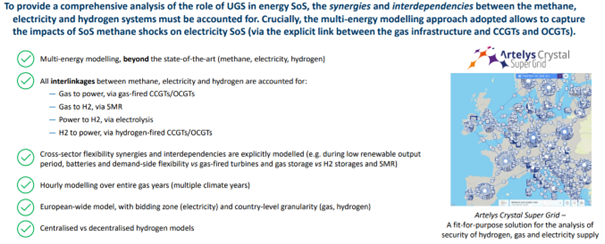
Artelys performed the quantitative analysis using Artelys Crystal Super Grid, a state-of-the-art modelling platform designed to capture complex interdepencies between methane, electricity and hydrogen systems. The modelling represents major flexibility options across all vectors and simulates the European system at hourly resolution over full gas years, with a national (gas) or bidding zone (electricity) geographical resolution.
The assessment focuses on 2030 and 2040, building on the TYNDP 2024 NT+ scenario and a deviation scenario used to stress-test the system under slower electrification uptake (slower methane demand decline). To quantify resilience, Artelys has evaluated the impacts of three security-of-supply stress conditions: a harsh winter (based on historical climate conditions), a LNG supply reduction, and a Norwegian supply reduction.
The specificities of UGS are well-captured as the model is based on AGSI datasets and reflect available capacities (working gas volume, injection and withdrawal capacities) per type of UGS (salt caverns, depleted gas fields, aquifers) at national level, taking into account the impact of storage level on injection and withdrawal capacity. This detailed setup is specifically suited to representing storage operation dynamics.
Key findings: storage remains essential, especially under stress
The modelling shows that while the drivers of gas system operation evolve with decarbonisation, UGS remains a critical flexibility asset for Europe’s energy system, not only for methane adequacy, but also for overall resilience in an increasingly interconnected methane-electricity-hydrogen landscape.
In the NT+ scenario, seasonal flexibility services remain broadly stable compared to recent years, with similar operational patterns.
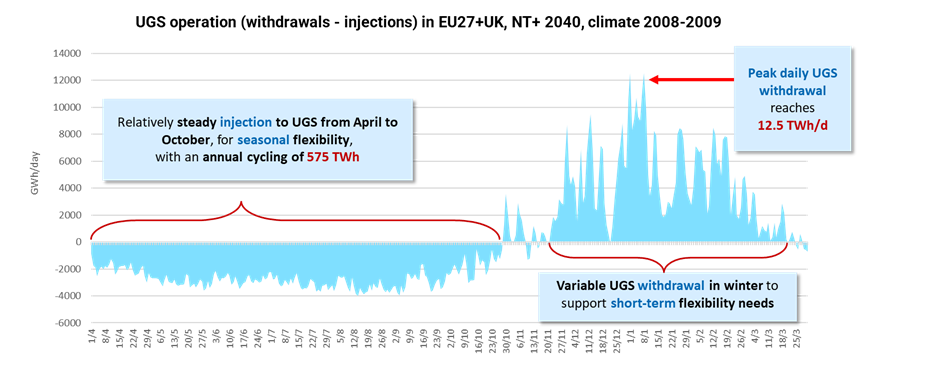
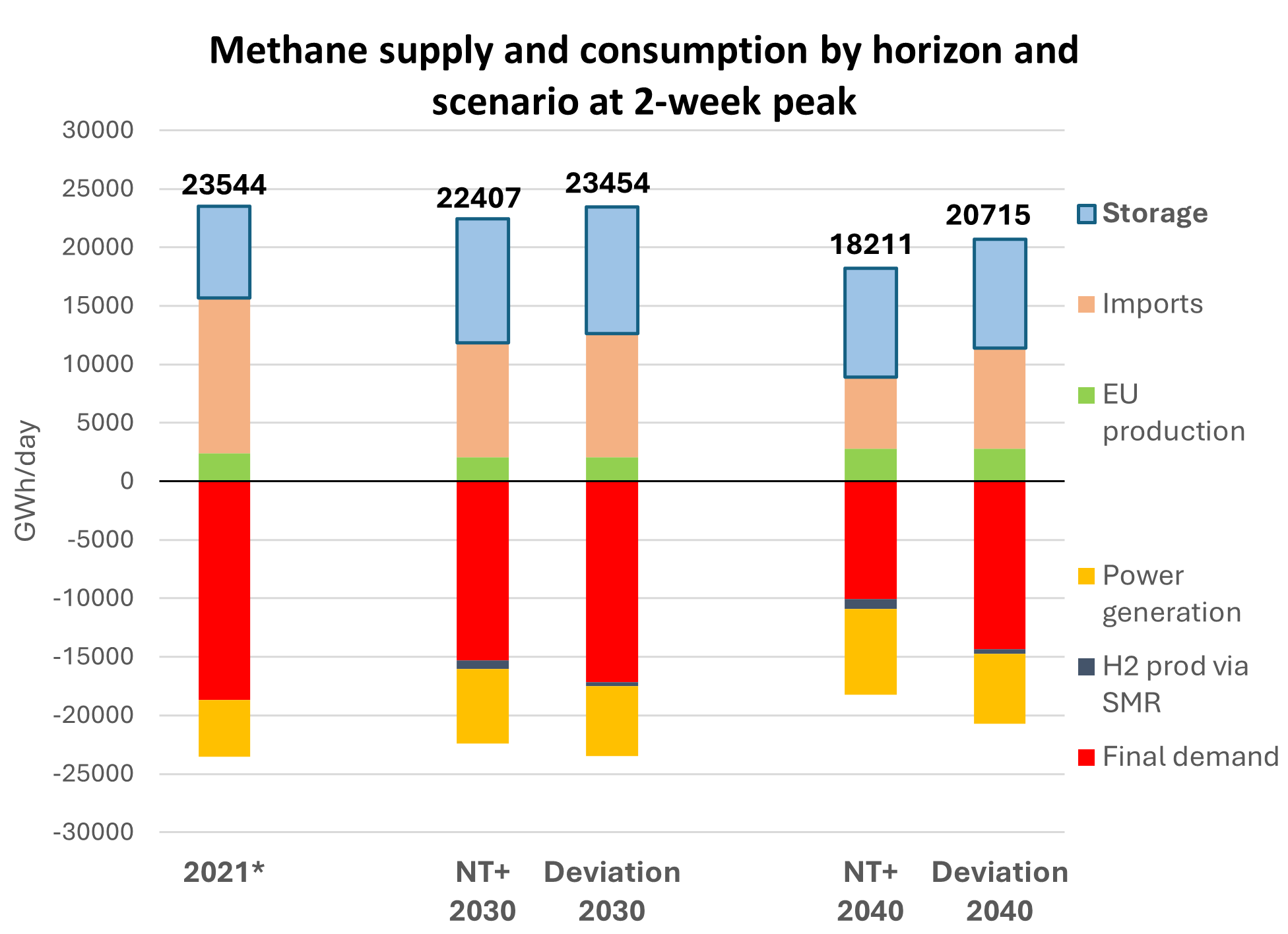
The study also quantifies how storage supports peak deliverability and system robustness under shocks. Between 2030-2040 and NT+2040, annual consumption decreases by 23% and daily consumption peaks by 12%, while UGS peak withdrawal supply increases by 15%, as import capacity contribution share decrease amid lower annual consumption volume. In particular, the role of UGS to support electricity security of supply increases, as peak daily methane demand for power generation is 10.7 TWh/day in NT+2040, while it was 5 TWh/day in 2021.
In stress situations, deliverability margins can become tight. These narrow deliverability margins could become insufficient if shocks occur late in the winter, if multiple shocks overlap, or if initial filling levels fall below 90%.
Overall this work illustrates Artelys’ ability to quantify system resilience to security of suply shocks with a robust multi-energy modelling framework, explicitly representing the interdependencies between methane, electricity and hydrogen in an integrated European energy system.
If you are facing similar challenges, namely the dimensioning of a system that is able to withstand shocks, we’d be more than pleased to have a conversation – do get in touch!
Read the full report for methodology details and full results.
Artelys Announces Major New Release of Artelys Crystal Super Grid
Artelys is thrilled to announce a new major release of Artelys Crystal Super Grid.
Artelys Canada joins IVADO to catalyze innovation in optimization and digital intelligence
We are pleased to announce that Artelys Canada has joined the IVADO community as an industrial member, marking the beginning of a new strategic partnership.
Artelys Knitro 15.1: Solve your toughest pooling applications!
Artelys releases Knitro 15.1, bringing a new wave of performance upgrades and usability improvements to help you solve large-scale optimization problems faster than ever.

Artelys contributes to SNCF Voyageurs’ OPTIPLACE project
Artelys is contributing to the development and industrialisation of the OPTIPLACE project, which aims to improve passenger seating arrangements on Ouigo trains by developing the optimisation module used for seat assignment.
subscribe to our newsletters


© ARTELYS • All rights reserved • Legal mentions