


Artelys Announces Major New Release of Artelys Crystal Super Grid

As energy systems become increasingly complex and interconnected, benefiting from advanced optimisation solutions can become a gamechanger. Artelys is thrilled to release a new major version of Artelys Crystal Super Grid, a solution dedicated to the dimensioning and optimisation of energy systems.
This new release packs a wide range of novelties and of behind-the-scenes improvements, allowing for an acceleration of planning and optimisation exercises and more robust and transparent workflows.
If you’d like to learn more, please don’t hesitate to contact our team for additional information, a demonstration, or access to a trial version.
The new main features of Artelys Crystal Super Grid are:
Advanced multi-energy capabilities
Artelys Crystal Super Grid has, from the start, enabled the modelling and optimisation of complex multi‑energy systems. Its asset library continues to expand, with advanced capabilities for electricity‑sector flexibility, improved cross‑vector coupling, and comprehensive parameters to refine the representation of imports of electricity and molecules.
Advanced multi-energy capabilities
Artelys Crystal Super Grid has, from the start, enabled the modelling and optimisation of complex multi‑energy systems. Its asset library continues to expand, with advanced capabilities for electricity‑sector flexibility, improved cross‑vector coupling, and comprehensive parameters to refine the representation of imports of electricity and molecules.
Enhanced maintenance scheduling capabilities
This improvement enables users to generate a single optimised maintenance plan across multiple test cases without initiating a dispatch optimisation process. The resulting schedule can then be stored and reused for other simulations. An additional parameter has also been added to take maintenance durations into account when scheduling maintenance.
Enhanced maintenance scheduling capabilities
This improvement enables users to generate a single optimised maintenance plan across multiple test cases without initiating a dispatch optimisation process. The resulting schedule can then be stored and reused for other simulations. An additional parameter has also been added to take maintenance durations into account when scheduling maintenance.
Facilitated edition of general constraints
It is now even easier to set constraints on groups of nodes or assets! Thanks to this capability you can implement a cap on CO₂ emissions, limit imports and exports, set limits on the way thermal units are allowed to be dispatched, etc. The user can choose whether these constraints are to be enforced strictly or implemented as soft constraints that may be violated at a specified cost.
Facilitated edition of general constraints
It is now even easier to set constraints on groups of nodes or assets! Thanks to this capability you can implement a cap on CO₂ emissions, limit imports and exports, set limits on the way thermal units are allowed to be dispatched, etc. The user can choose whether these constraints are to be enforced strictly or implemented as soft constraints that may be violated at a specified cost.
New feature to identify marginal units more precisely
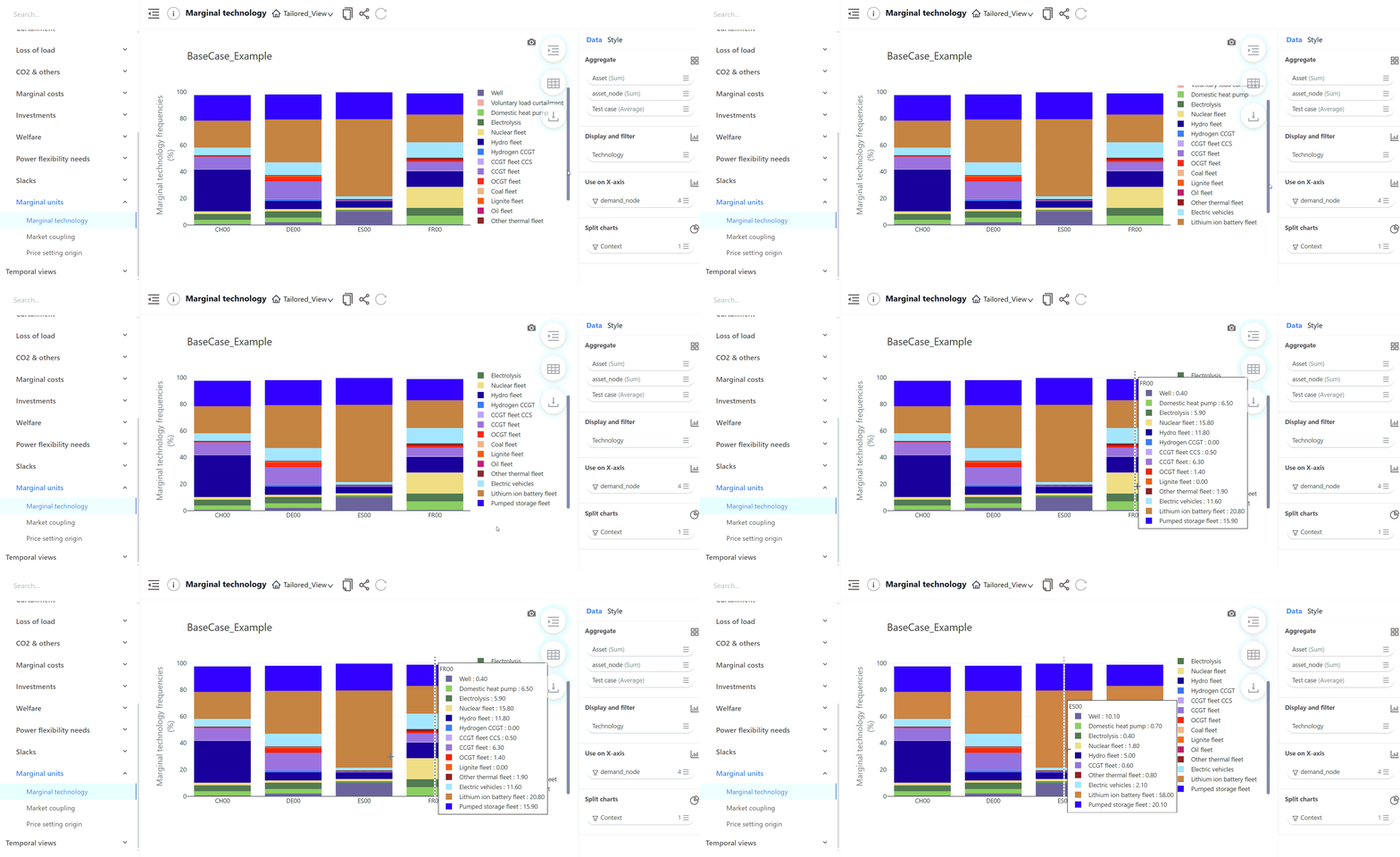
The marginal unit identification feature is a post-processing analysis that determines which units would increase their output to meet an additional unit of demand at a given hour and in a given zone. This feature is particularly relevant to analyse the role of gas-fired assets in electricity price formation. To enable this analysis, the application exploits the structure of the underlying mathematical optimisation problem in a completely novel way.
New feature to identify marginal units more precisely
The marginal unit identification feature is a post-processing analysis that determines which units would increase their output to meet an additional unit of demand at a given hour and in a given zone. This feature is particularly relevant to analyse the role of gas-fired assets in electricity price formation. To enable this analysis, the application exploits the structure of the underlying mathematical optimisation problem in a completely novel way.
Enhanced traceability
Users now have access to an extensive set of logs, enabling them to more easily monitor computation workflows and perform faster diagnosis when a simulation is found to be infeasible.
Enhanced traceability
Users now have access to an extensive set of logs, enabling them to more easily monitor computation workflows and perform faster diagnosis when a simulation is found to be infeasible.
Microservice architecture
The architecture of Artelys Crystal Super Grid is based on a modular structure that seamlessly connects the web interface, server, database, and computing resources to deliver reliable and high-performance services. It can easily integrate with external tools (e.g. databases, monitoring solutions, etc.) and ensure flexibility, scalability, and smooth operation. This architecture also facilitates the orchestration of complex computation workflows – running thousands of simulations is now as simple as running a single one.
Microservice architecture
The architecture of Artelys Crystal Super Grid is based on a modular structure that seamlessly connects the web interface, server, database, and computing resources to deliver reliable and high-performance services. It can easily integrate with external tools (e.g. databases, monitoring solutions, etc.) and ensure flexibility, scalability, and smooth operation. This architecture also facilitates the orchestration of complex computation workflows – running thousands of simulations is now as simple as running a single one.
Source: Artelys Crystal Super Grid, Map view and filters.
If you’d like to learn more, please don’t hesitate to contact our team for additional information, a demonstration, or access to a trial version.

Artelys: Our solutions for maximising the value of hydropower assets
Hydropower plays a strategic role in the energy transition thanks to its unique ability to provide flexibility, storage, and dispatchability to the electricity system. However, managing hydropower systems is becoming increasingly complex: hydrological uncertainty linked to climate change, market volatility, evolving grid needs, and aging assets all call for a rethink of decision-making methods.

Supporting Lithuania’s Energy Security: National Resource Adequacy & Flexibility Needs Assessment for Litgrid
— Artelys is proud to have delivered a National Resource Adequacy Assessment (NRAA) for Litgrid, following the ENTSO-E ERAA methodology, alongside a Flexibility Needs Assessment (FNA) based on the framework set out by ACER.

Artelys Knitro 16.0: Model Nonlinear Problems Natively, Solve Them Concurrently
Artelys is pleased to announce the release of Knitro 16.0, a major version introducing two flagship features — a native Nonlinear Modeler and a Concurrent Solver — alongside significant performance and robustness improvements for nonlinear, mixed-integer and linear optimization problems.

First Successful Auction for the New French Capacity Mechanism!
— The first auction of the new French Capacity Mechanism was successfully held on Monday, 6 July 2026. Artelys is proud to provide the market clearing algorithm used to select the accepted capacity offers.
subscribe to our newsletters


© ARTELYS • All rights reserved • Legal mentions