


Supporting Lithuania’s Energy Security: National Resource Adequacy & Flexibility Needs Assessment for Litgrid
Lithuania’s power system is undergoing a major transformation, driven by rapid renewable deployment, synchronisation with Continental Europe, evolving interconnection patterns, and the progressive retirement of thermal dispatchable assets. In this context, the study combines a National Resource Adequacy Assessment and a Flexibility Needs Assessment over the 2028–2037 horizon, following ENTSO-E and ACER methodological principles to assess Lithuanian energy system adequacy and flexibility.
First, the Economic Viability Assessment indicates that wholesale energy market revenues alone are not sufficient to support new thermal generation or battery storage investments. In addition, only existing thermal units that do not require a lifetime extension remain economically viable (except combined cycle unit of the Elektrenai complex LE_KCB) over the 2028–2037 period, together with new explicit DSR potentials starting in 2033. The continued operation of plants requiring lifetime extensions, as well as LE_KCB, is not economically viable.
Relying on this mix of capacities, adequacy in the Central Scenario complies with the 8-hour criterion in 2028 – the average number of Loss of Load hours over the Monte-Carlo simulations is lower than 8 hours – but exceeds it from 2030 onwards. Adequacy events are concentrated in extreme scenarios driven by adverse weather conditions. Further sensitivities show that adequacy is highly sensitive to interconnection availability: short-term HVDC outages increase Expected Energy Not Served (EENS) by a factor of about 4 on average, while long-duration losses of NordBalt and Estlink lead to much larger deficits (around a factor of 30). To address these adequacy issues, remedial installation of thermal capacities proves effective, making it possible to meet the 8-hour criterion with 0.4 GW of new CCGT in the Central Scenario, 0.8 GW under short-term HVDC outages, and up to 2.6 GW in the Baltic region under long-term HVDC outages. These results highlight the importance of Baltic interconnection reliability, domestic thermal capacity and, where necessary, capacity remuneration mechanisms to bridge the gap between market viability and adequacy needs.
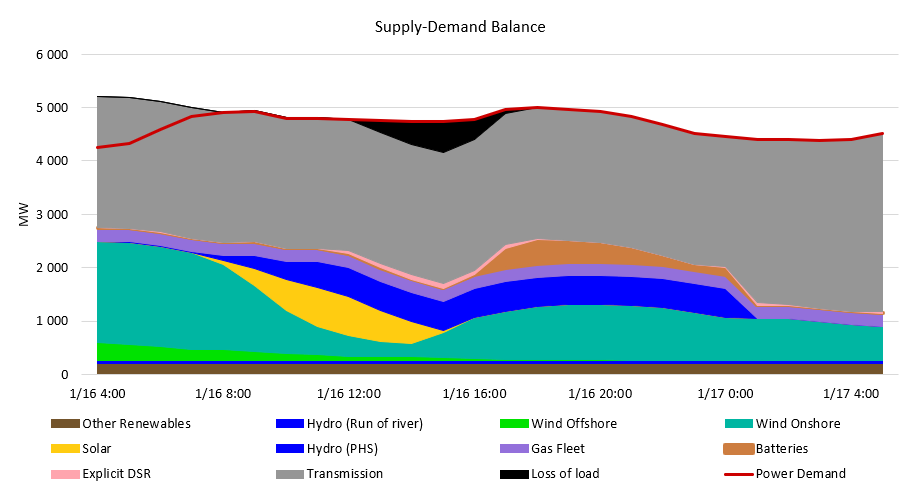
Production mix of the Lithuanian electricity system over a few hours, illustrating a period of failure.
While RES capacities do not play a key role in Lithuanian adequacy, they are a key component in Lithuanian net position as soon as the Lithuanian electricity system is sufficient flexible to capture this variable generation. Based on the simulations handled, flexible capacities are able to handle RES curtailment, which remains moderate overall but increases by 2035 and becomes highly sensitive to interconnection availability. Flexibility needs are predominantly short-term and are mainly covered by interconnections, batteries and electrolysis, while thermal units play only a marginal role in RES integration. Additional large-scale storage investments considered are viable over the period, contributing to both flexibility and adequacy.
Overall, the results underline the need to coordinate adequacy measures, interconnection development, cost-efficient DSR, storage deployment and non-fossil flexibility development in order to support both security of supply and renewable integration.
Whether you’re interested in resource adequacy, flexibility challenges in power systems, or in Artelys Crystal Super Grid as a tool to address them — feel free to reach out!
Read the full report and consult the presentation on the study’s results right here!
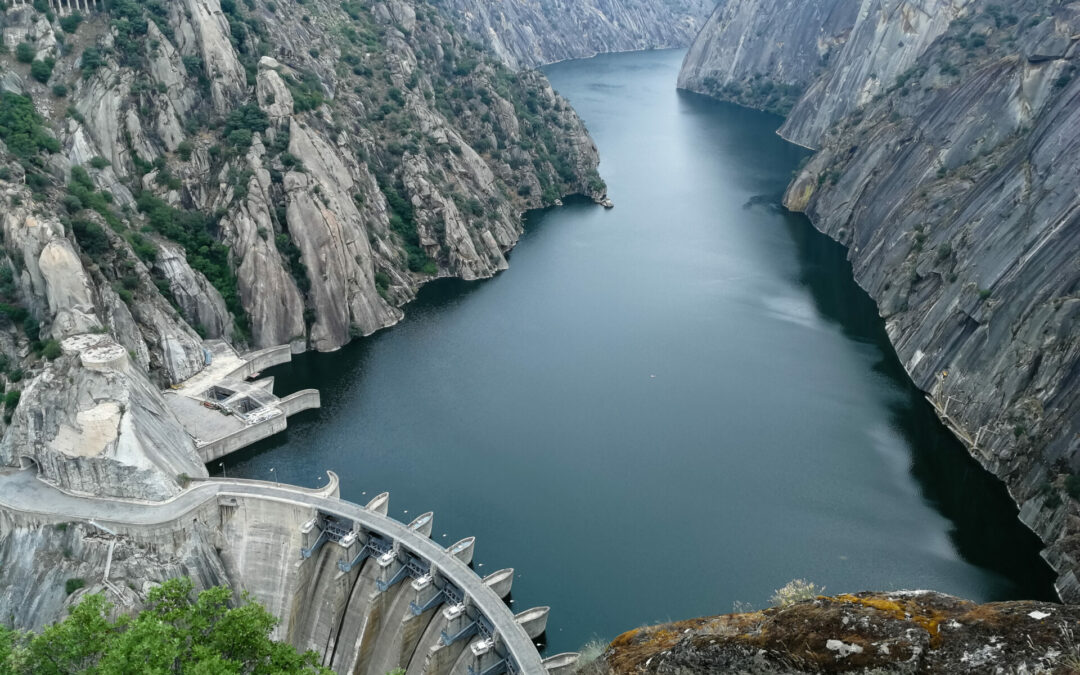
Artelys: Our solutions for maximising the value of hydropower assets
Hydropower plays a strategic role in the energy transition thanks to its unique ability to provide flexibility, storage, and dispatchability to the electricity system. However, managing hydropower systems is becoming increasingly complex: hydrological uncertainty linked to climate change, market volatility, evolving grid needs, and aging assets all call for a rethink of decision-making methods.
Artelys Knitro 16.0: Model Nonlinear Problems Natively, Solve Them Concurrently
Artelys is pleased to announce the release of Knitro 16.0, a major version introducing two flagship features — a native Nonlinear Modeler and a Concurrent Solver — alongside significant performance and robustness improvements for nonlinear, mixed-integer and linear optimization problems.

First Successful Auction for the New French Capacity Mechanism!
— The first auction of the new French Capacity Mechanism was successfully held on Monday, 6 July 2026. Artelys is proud to provide the market clearing algorithm used to select the accepted capacity offers.
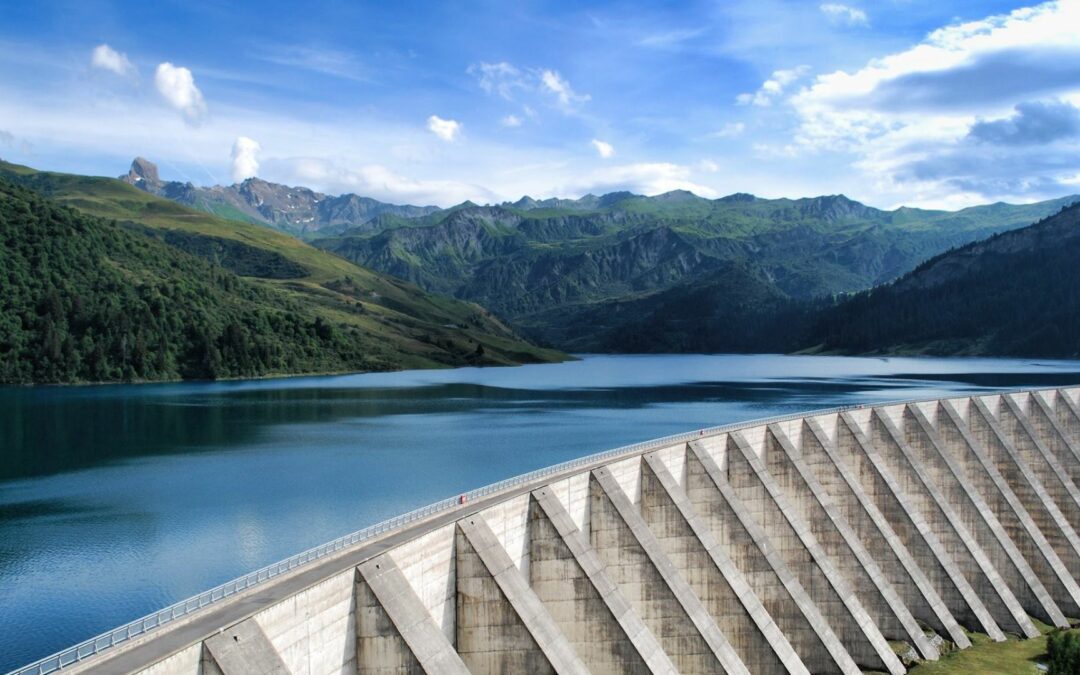
Artelys compared the compensation mechanisms available for hydropower across global electricity markets in collaboration with CEATI
— Artelys is proud to have issued a new report published by CEATI, providing a comprehensive benchmark of compensation mechanisms available to hydropower assets across electricity markets in North America, Europe, and beyond.

