


H2CliP Project
— Based on the 2022 Joint Declaration of Intent establishing the Canada-Germany Hydrogen Alliance, the initiative seeks to advance a transatlantic hydrogen trade corridor that drives the hydrogen economy, supports the global energy transition, strengthens climate action, and enhances energy security.
In response to the call for proposals on low-carbon hydrogen technologies, the consortium submitted the H2CliP project, bringing together six partners to develop a collaborative approach for modeling and evaluating low-carbon hydrogen applications, impacts, and benefits within the Canadian and German energy systems.
Hence, the overall goal of H2CliP is to assess how hydrogen can be integrrated into transformation pathways toward carbon neutrality in Canada and Germany, and to elaborate the role of hydrogen as a basis for restructuring industrial value chains.

project presentation
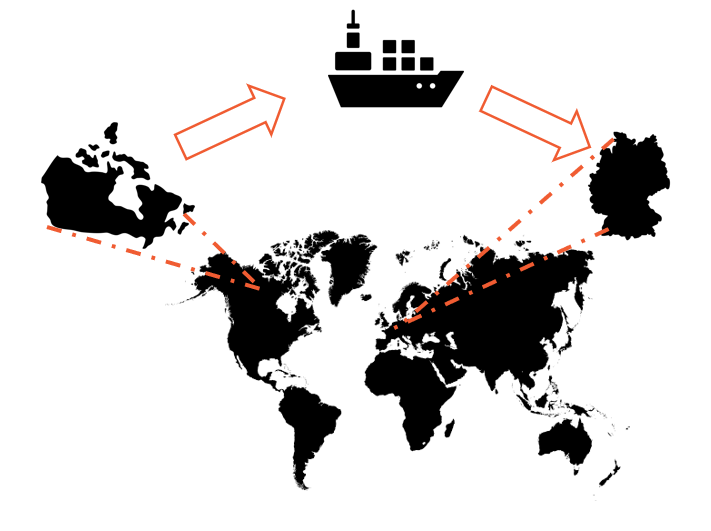
The H2CliP project is a three-year R&D initiative (2023-2025) dedicated to advancing knowledge and cooperation around the development of a transatlantic hydrogen economy. Through multi-level modeling and analysis, the project explores the potential for green hydrogen productions in Canada and Germany, as well as the opportunities for bilateral trade between the two countries.
Energy System Analysis
Modeling and simulating energy systems to assess how industries and energy sources can transition towards climate neutrality within an international partnership.

Economic Analysis
Evaluating the macroeconomic and sectoral impacts of hydrogen value chain restructuring, including effects on GDP, value added, and downstream industries.

Life-Cycle Assessment
Quantifying the carbon footprint of hydrogen value chains between Canada and Germany.
This project is supported in part by advisory services and research and development funding from the National Research Council of Canada Industrial Research Assistance Program (NRC IRAP), as well as as well as through the NRC’s National Program Office (NRC NPO). Project partners from Germany are supported through the Federal Ministry of Research, Technology and Space (BMFTR) under Funding Label 01DM22002A.
stakeholders and tools





University of Stuttgart (IER)
The Institute of Energy Economics and Rational Energy Use (IER) develops solutions to energy challenges at the intersection of technology, economy, environment and society.
- TAM-Supply is a technology-oriented, actor integrated, linear optimization model representing the German energy supply system.
- NEWAGE is a global, recursive-dynamic general equilibrium model with special focus on the energy sector.
Artelys Canada Inc.
Artelys is an independent company specializing in mathematical optimization, modeling and decision suppport, especially in the energy domain.
- Artelys Crystal Super Grid is a web-based bottom-up power system model with an hourly time resolution. It is used for strategic planning, to evaluate the costs and benefits of infrastructure projects, assess the impacts of proposed measures, and optimize investments in generation assets, grids and flexibility solutions.
Clean Energy Innovation (CEI) – NRC
The National Research Council of Canada (NRC) is the Government of Canada’s largest research and technology organization. NRC’s Clean Energy Innovation (CEI) Research Centre catalyzes solutions for net-zero energy, critical minerals, advanced materials and industrial decarbonization to accelerate Canada’s transition to a thriving net-zero economy.
- Of NRC’s four tasks, in the Life Cyle Analysis (LCA) task, NRC’s modeling tool was adapting the Ecoinvent v3.8 processes in OpenLCA.
Group for Research in Decision Analysis (GERAD)
The GERAD is an inter-university research center based in Montreal, bringing together about 120 members, specialized in data and decision sciences. GERAD advances the mathematics of decision-making in complex systems, with applications in economy and energy systems, as well as in domains such as smart infrastructure and smart logistics.
- AD-MERGE is a global integrated assessment model that analyzes interactions between energy, economy, and climate systems, explicitly incorporating adaptation and mitigation strategies.
- ETEM-ML is a detailed bottom-up energy model of the Greater Montreal’s energy sector, designed to assess pathways for the urban energy transition.
ESMIA Consultants Inc.
ESMIA is a leader in integrated energy-economy-environment (E3) systems modeling, providing rigorous analysis to support strategic decisions on energy transition, security, and climate goals. Leveraging proprietary models, high-quality data, and partnerships with top research institutes and the International Energy Agency, ESMIA serves governments, industry, and organizations worldwide with scenario studies, policy analysis, and custom modeling solutions.
- North American TIMES Energy Model (NATEM) is the only economy-wide optimization energy system model for North America, providing a rigorous analytical basis to identify least-cost pathways for achieving energy and climate objectives across all sectors while supporting economic growth.
- North American General Equilibrium Model (NAGEM) is a dynamic multi-region model that analyzes economic transformation, capturing the effects of energy policies and integrated pathways on GDP, trade, labor, and sectoral dynamics.
Siemens Energy Global
GmbH & Co, KG
As part of Siemens Energy, Grid Consulting delivers expert advisory services in power systems and provides techno-economic consultancy for energy projects. It supports energy system transformation to ensure a reliable, sustainable, and digital energy future.
- PyPSA-Eur is an open model dataset of the European energy system at the transmission network level that covers the full ENTSO-E area. It covers demand and supply for all energy sectors.
collaborative approach
— Literature Review
— Major insights and key messages
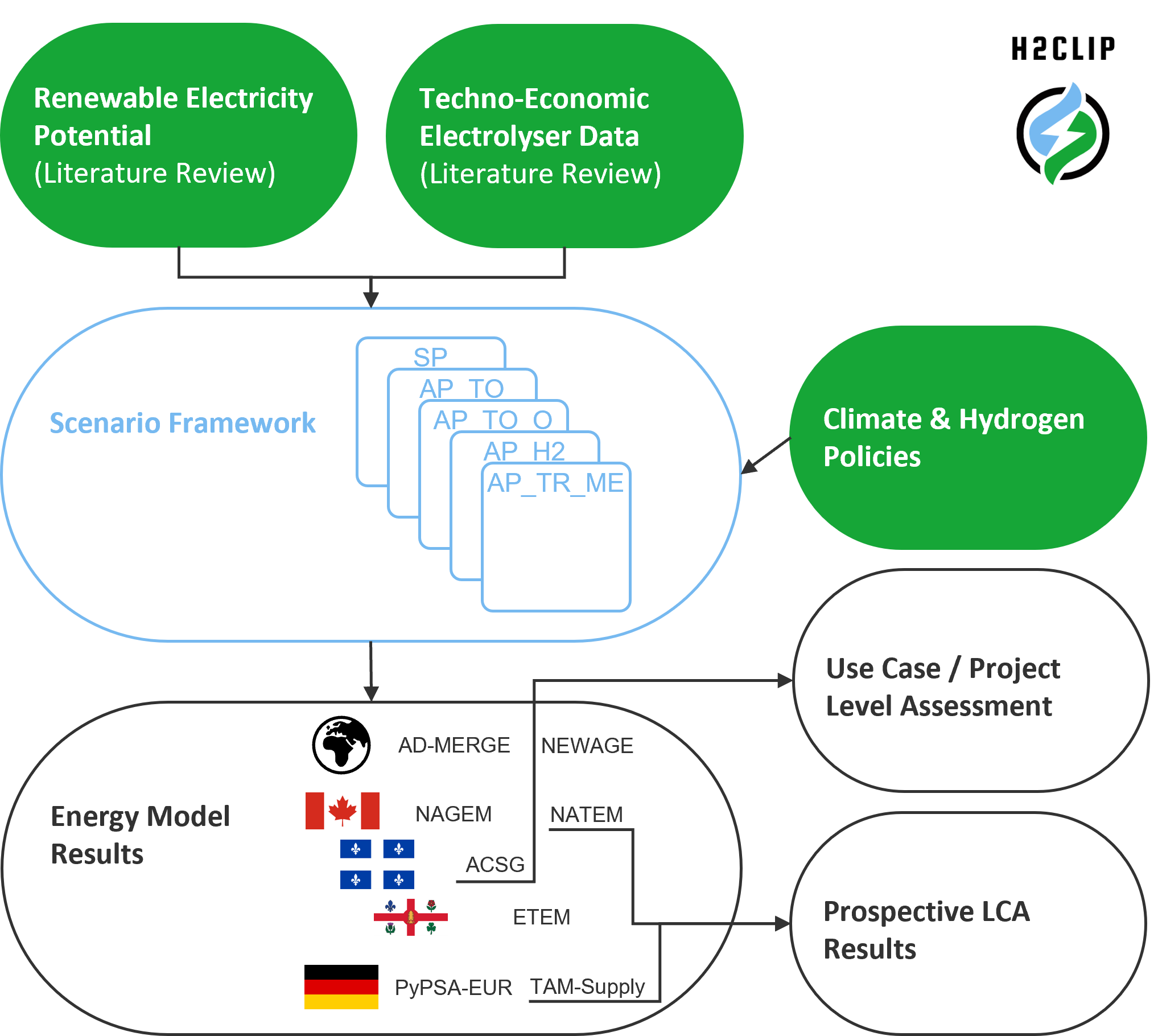
Based on the standard “Announced Pledges Technology Open” scenario, three variations are developed:
- “Announced Pledges Technology Open Optimistic” assuming more optimistic developments in Electrolyser CAPEX, OPEX, and efficiency.
- “Announced Pledges Hydrogen Focus” where all countries worldwide achieve their low-carbon hydrogen production targets through subsidies.
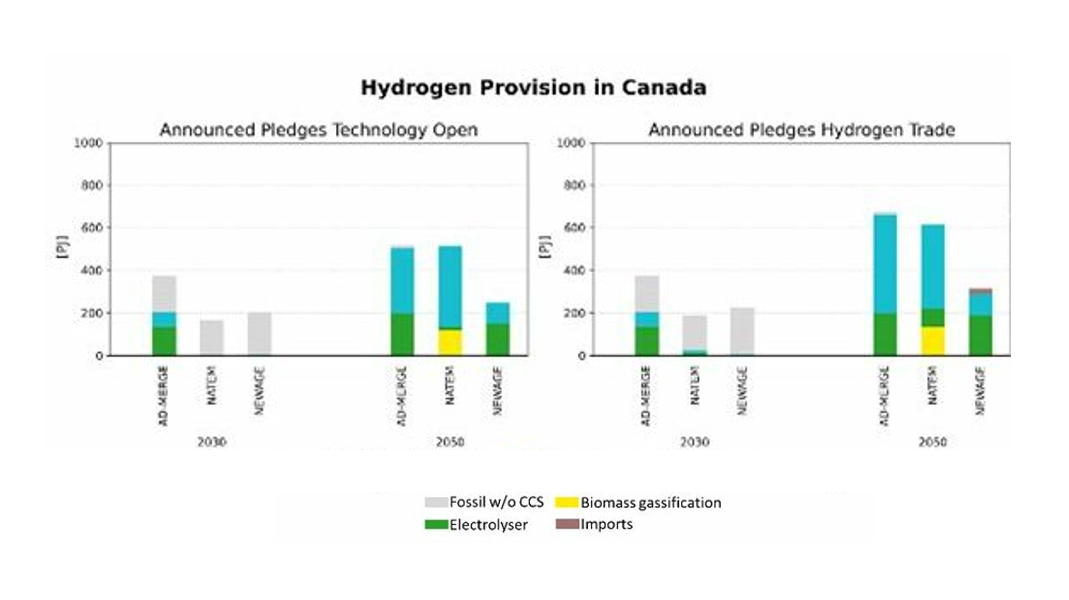
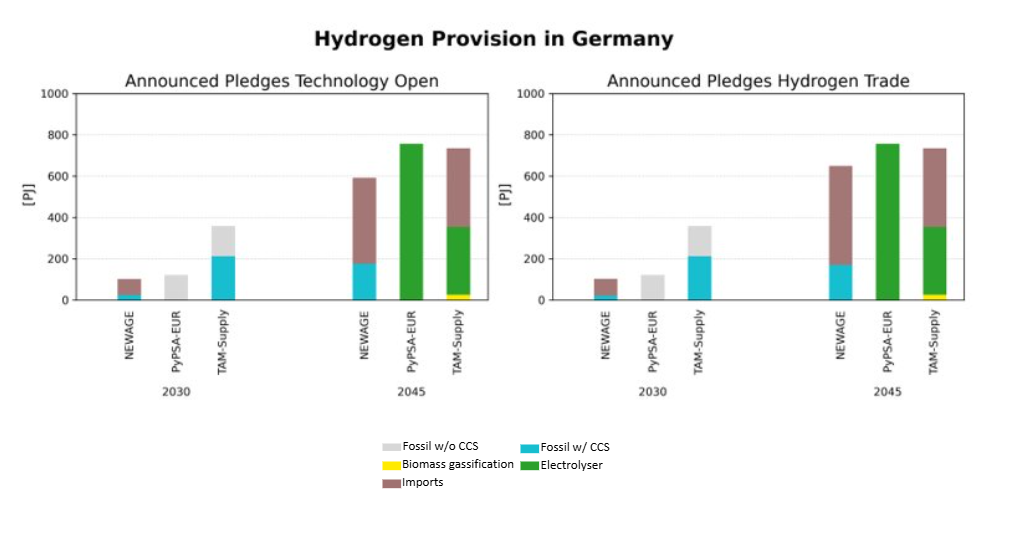
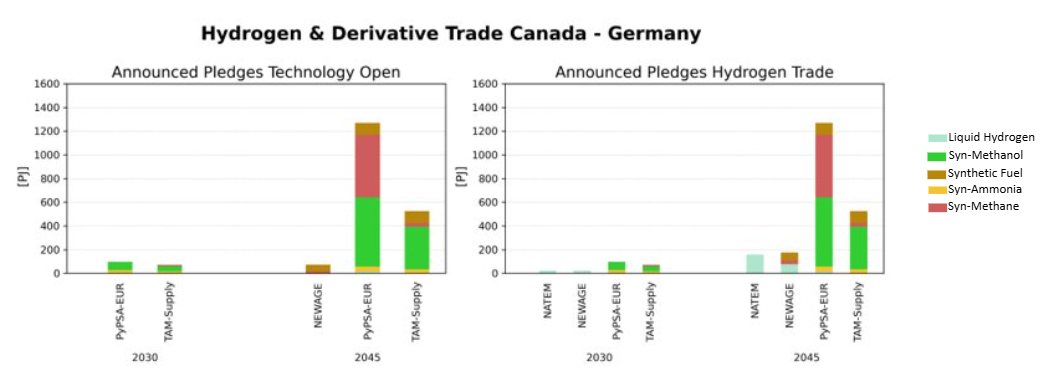
- “Announced Pledges Hydrogen Trade” where Canada and Germany subsidize Canada-Germany hydrogen and derivative trade to achieve amounts based on the German Hydrogen Import Strategy.
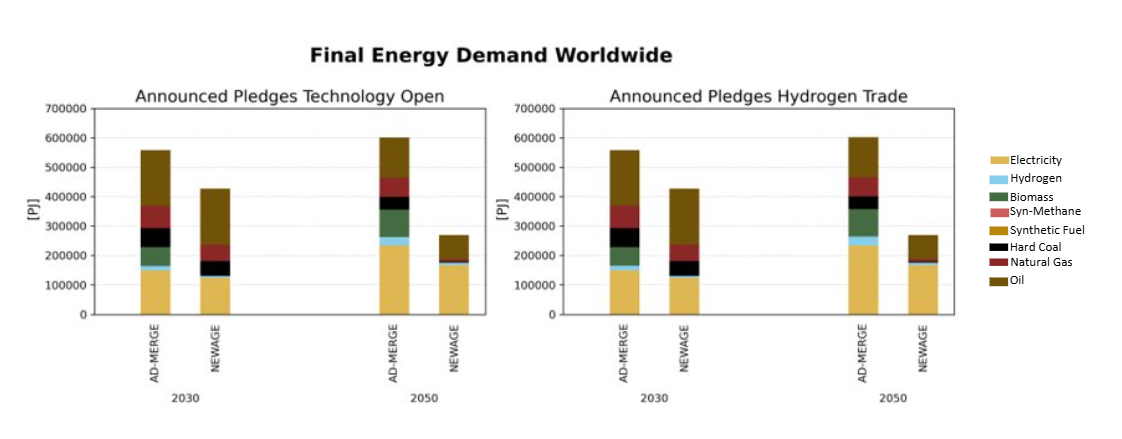
In 2050, global model results show different perspectives on the long-term development of total final energy demand. In both AD-MERGE and NEWAGE models, a rise of electricity and hydrogen shares in the final energy use can be observed, but for hydrogen, the growth is less strong.
On a national level, model results for Canada and Germany illustrate how the climate targets drive the phase-out of unabated fossil-based hydrogen production.
In the Announced Pledges scenarios, besides “Announced Pledges Hydrogen Trade“, substantial hydrogen or derivative exports from Canada to Germany appear only in PyPSA-EUR and TAM-Supply. These models focus on the German energy system and include a comprehensive set of hydrogen derivative options in international trade.
In contrast, NATEM and NEWAGE are limited in the range of derivatives that could be traded internationally and take domestic Canadian hydrogen demand into account. Consequently, these models show much smaller or no Canada-Germany trade without trade subsidies.

On a regional level, the Artelys Crystal Super Grid model reports large amounts of electrolytic hydrogen production in the Canadian province of Quebec, with electrolysis playing an important role in stabilizing the electricity grid through capacity services.
At the same time, results of the ETEM model for the Greater Montreal region show a marked increase in hydrogen demand, particularly between 2040 and 2050, primarily driven by the decarbonization of heavy transport and industrial applications.
Based on the modeling results, the greenhouse gas emissions associated with hydrogen supply from Canada to Germany are assessed in a prospective Life-Cycle Assessment under the Announced Pledges Hydrogen Trade scenario. Key findings highlight that using ammonia as a carrier is associated with a higher GWP100 compared to liquid hydrogen. Moreover, even in electricity systems free of fossil generation, GHG emissions persist due to the embodied emissions within the required infrastructure.
project outcomes
— Capacity building and training
Training opportunities included:
One postdoctoral fellow, eight PhD students, six MSc students, five interns, three early career energy modelers, alongside the recruitment of full-time researchers.
— Model Development
Partners developed and enhanced national and international models, including sector-coupled frameworks, detailed hydrogen modules, supply-chain representations and carbon accounting tools.
These models support the assessment of hydrogen’s role in low-carbon pathways, investment strategies and the restructuring of industrial value chains
— Scientific Dissemination
- Four international conference prestations: invited speaker at Hy Fcell Canada (2024, 2025), at GERAD and Energy Modelling Hub (EMH), and panel organization at Hy Fcell Stuttgart 2025 (Canada-Germay, 3 and 2 low carbon hydrogen panels).
- One Journal Paper (plus one manuscript in progress): Renewable and Sustainable Energy Reviews, Vol. 215, June 2025, 115544.
- Two Technical Reports (plus one report in progress): Cahier du GERAD G-2025-74 (manuscript pre print); G-2024-20 (RSER pre print).
- One web page: a site was created to summarize the collaboration, the partners, the capabilities developed, the impacts for each partner, as well as publicly accessible outputs.
- Organisation of two learning dialogues per year (five total), with an average of ten external experts invited per session, fostering knowledge exchange and community building, including a final Outreach Day where project results were presented (Canada Germany, 3 and 2 stakeholders who initiated the low carbon hydrogen call also attended).
contact us


© ARTELYS • All rights reserved • Legal mentions